Showing posts with label Panasonic. Show all posts

20 November, 2014

Panasonic NN-DS592B Combination Microwave Oven

I bought this oven, thinking it could replace several kitchen appliances: conventional (normal, baking) oven, toaster, steamer and microwave. Unfortunately I don't recommend it as it's ridiculously difficult to use. At first I thought I was growing old when I couldn't understand the manual. Now, having tried to use the oven, I found out it's not me. I also have a Panasonic fridge and the manual is similarly hard to understand / missing information, so maybe Panasonic just isn't good at writing manuals. A pity, because I was quite happy with their TV.

Ok so what's so hard to use about it?
  1. It has many modes (that's fine, that's why I bought it), but it doesn't clearly state what kinds of heating each mode uses. e.g. does combination use microwaves? Does double-grill use microwaves? (answer: yes and yes) This is important, because you need to know whether you can use metal in such modes.
  2. You'd think all the modes are equivalent, but for some reason they're spread out all over the controls and manual. I mean, some are above the round knob and some are below.
  3. It comes with no less than FOUR trays, TWO of which can only be used in ONLY ONE MODE EACH. The LCD even has an indicator which tray to use, but the icons all look similar. It also has a reference table showing which trays and modes are compatible.
This is way beyond what you can expect the average household to learn.

For example, I was trying to grill a sausage. So I put aluminium foil on the double-grill tray and used the double-grill mode. Does the double-grill use microwaves? See above. "Hmm, does my sausage contain glitter?" "No? It's sparking, then"

Ok fine, switch to the normal, conventional oven mode. This should be fine, right? What's that plasticky smell? Check the reference table. THE DOUBLE-GRILL TRAY IS ONLY FOR THE DOUBLE-GRILL MODE! Why? BECAUSE THE BOTTOM OF THE TRAY HAS PLASTIC! (Aside: I think the double-grill mode uses the heating element to cook from the top, and the tray absorbs microwaves to cook from the bottom, because it has no bottom heating element)

23 June, 2013

Panasonic Air Purifiers

I found this information sheet on Panasonic air purifiers. It contains:
  • (Asia) F-PXF35A, F-PMF35A, F-PXC50A, F-PJD35A
  • (Middle East) F-PXF35M, F-PMF35M, F-PXC50M, F-PJC35M
And lists:
  • Air volume
  • Power consumption
  • Noise
  • Applicable area
  • Ion
  • Filter life time
  • Motor type
  • 3D airflow (lower suction)
  • Sensor
  • Clean sign
  • Auto mode
  • Turbo mode
  • Sleep mode (8 hours)
  • Filter life check
  • Dimension
  • Weight
For the F-PJD35A, air speed ranges from 3.5 to 0.9 m3/min, power consumption from 32 to 6.5 W, it's suited for 26 m2 and weighs 6.3 kg.
Full size: https://blogger.googleusercontent.com/img/b/R29vZ2xl/AVvXsEgrHifOdg61y2sgo5byWIeae5UQzrFXPEcAcfB3uJbWaUo3AZ1AVDECN_-FVbc43tQcTcB7KFbZHMZhFYZwyfZmmHhTkUTJNipeQKA-9Bypa4nD-iyhdanPmWVG3cKI1vvF8FcDkkpKuhg/s0/panasonic%2520air%2520purifier%25206.jpg

12 February, 2012

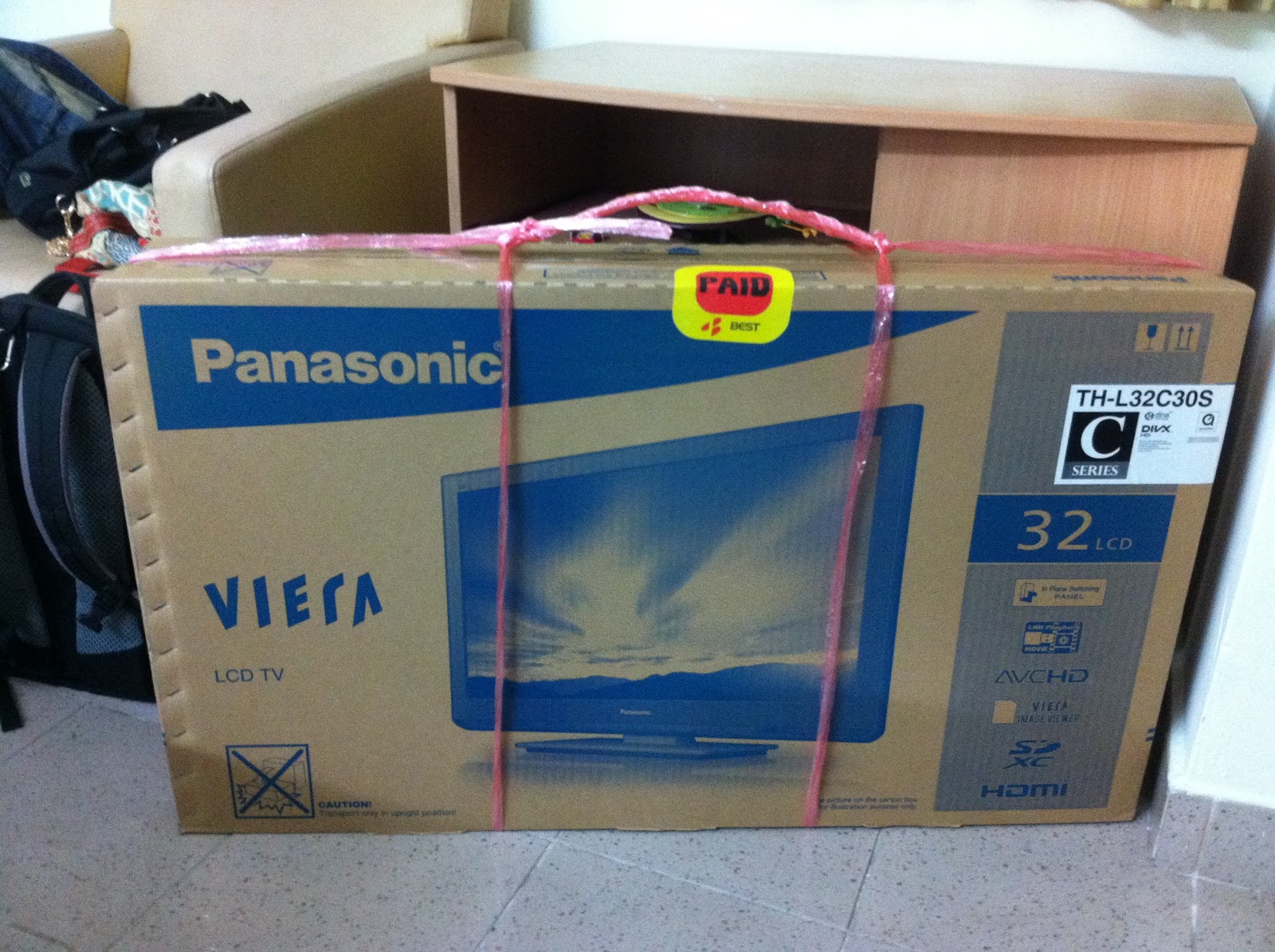
Panasonic TH-L32C30S 32" LCD TV

When looking for a TV recently, I found out TVs now can roughly be divided into 3 categories. In increasing price/performance:
  1. LCD
  2. LED
  3. 3D

In the end I bought the Panasonic TH-L32C30S 32" C-series Viera LCD TV for $399. Originally I was looking for a full HD (1080p) TV, but I got this (720p) in the end because there were no 1080p TVs in my budget, and I didn't have space for a 40" TV. To get the full benefit of a 1080p TV at 32" you also have to sit pretty close to the TV.

Specifications
  • 1366x768 resolution
  • Inputs: 1 component, 2 composite, 3 HDMI, VGA, 2 USB, SD card
  • On SD and USB, it supports formats avi (divx, xvid, mpeg4), mp4, mov and several others
  • 99W power consumption, 0.25W standby

Hardware
  • The TV is only 9kg! The whole package is 12kg.
  • I think the TV is very well designed. I'm not very updated with TVs so I don't know how standard these features are. There is a set of inputs on the side for ad-hoc connections. There is a set of buttons on the other side to control the TV without the remote. You can use these buttons to turn on the TV without the remote.
  • I am most impressed with the HDMI input on the side - you can use audio from the HDMI, or if you're connecting it to an old computer like I am or using DVI to HDMI, there won't be any audio in the HDMI stream. You can tell the TV to use analog (red and white) audio input!
  • The LCD panel is IPS, like the iPhone 4 and iPad. This gives very good viewing angles. I think for computer monitors you can only get the smallest IPS ones for $399.

  • The USB port can charge iPhones! (phone displayed "charging". Did not wait to see if battery level went up)

Software
  • TV can store audio volume and colour adjustments for each channel
  • TV can black out the screen to save power, leaving only audio
  • In Game mode, it can remind you how long you've spent playing
  • You can rearrange and name channels
  • Rename inputs (e.g. HDMI1 to DVD)
  • The menus are intuitive and easy to use, but I can't remember the difference between "menu" and "option" on the remote.

In short, it seems like a fully-featured TV. Did I mention the C-series is Panasonic's entry level?

Power measurements:

  • Off - 2 W (if you turn it off using the remote, it uses 11 W for a while, then drops to 2 W)

TV (analog for now)

  • Audio off - 73 W
  • Audio and screen off - 34 W
  • Audio and screen off, charging iPhone - 37 W

28 May, 2011

Panasonic F-PJD35A air purifier

I've always wanted an air purifier. I think dirty air is underestimated. I've tried a few cheap air purifiers but they were useless, so don't waste your money. The good ones are about $400 onwards, but I didn't want to buy one with no way of measuring how good they were. I saw this on sale at half price ($299), so I decided to finally try one.

Basically, it's a filter and a fan, with a nano/ion generator. Personally, I don't really like ions from air purifiers because I'm not sure what they do. The brochure for this has reports saying their ions kill viruses/bacteria.
This is the front of the main filter
Back.
The second, deodourising filter. It has a very interesting structure, like black crystals grown on a grid.

At full power, it uses 32W. At minimum power, 6.5W. Maintenance: vacuum the front of the main filter (black) once every 2 weeks. Filters last 2 years.

  • It seems to be on its way out. Panasonic's Singapore and Malaysia websites have no air purifier section, although the model shows up on their website on Google searches. I had a hard time finding the manual online, and finally found it on the Hong Kong website.
  • Has dust sensor, and can automatically control its power according to amount of dust.
  • Sensor sensitivity can be adjusted
  • Quite quiet and uses little power
  • Long filter life
  • No HEPA
  • Filter frame is made of cardboard, I read this may lead to poor sealing and air bypassing the filter, but looking at the dust accumulated this doesn't seem to be a problem.
  • I'm afraid I'll drop something into the vent on top and it'll destroy the fan. I hope the fan isn't directly beneath the vent. All the other air purifiers I've seen also have the vent on the top.
 After 2 weeks, there is a visible layer of dust, although it's hard to see in this picture.

Sharp's air purifiers using Plasmacluster are quite famous. I found Plasmacluster works by splitting water molecules into H+ and OH- ions, which deactivate viruses and bacteria. According to Panasonic, "a nanoe is a fine (5 to 20 nm) and weakly acidic water particle with a reactive substance and an electric charge", "nanoe comes from condensed moisture in the air". I wonder if they're similar?

If I were to get another air purifier, I'd look for:
  • HEPA filtration
  • UV disinfection (I trust it more than nanoe)